Build an AI Deepfake Image Detection System: A Beginner’s Guide to Multi-Evidence Digital Forensics
Learn how to build an AI-powered deepfake image detection system that combines computer vision, image forensics, metadata analysis, and explainable AI for reliable digital investigations.
Imagine you’re a journalist covering a breaking news story. Someone sends you an image that appears to show a famous politician accepting a suitcase full of cash. Within minutes, the image spreads across social media. News outlets begin reporting it. People become angry. But there’s one problem.
The image might be fake.
Modern AI can now generate photorealistic faces, edit existing photos, and create convincing fake evidence in seconds. Looking at an image with your own eyes is no longer enough. So how do forensic investigators determine whether an image is genuine?
The answer isn’t a single AI model. Instead, investigators combine multiple independent pieces of evidence—just like detectives solving a crime. In this tutorial, you’ll build an AI-powered image forensic pipeline that inspects an image from every angle before reaching a conclusion.
What You’ll Build
The code is available in Github : Deep Fake Image Detection and Forensic Analysis
By the end of this tutorial, you’ll understand how to build an AI-powered digital forensic system that investigates images using multiple independent detectors.
You’ll learn how to:
✔ Validate uploaded images before analysis
✔ Measure image quality
✔ Detect and analyze faces
✔ Use a deepfake classifier
✔ Perform Error Level Analysis (ELA)
✔ Detect JPEG recompression artifacts
✔ Analyze image noise
✔ Examine frequency patterns using FFT
✔ Inspect image metadata
✔ Combine multiple evidence sources
✔ Generate explainable AI decisions
✔ Produce a professional forensic report using an LLM
System Architecture
                  Uploaded Image
                         │
                         ▼
              Image Validation
                         │
                         ▼
             Image Quality Assessment
                         │
                         ▼
                 Face Detection
                         │
                         ▼
              Deepfake Classifier
                         │
        ┌────────────────┼─────────────────┐
        ▼                ▼                 ▼
 Image Forensics      FFT Analysis     Metadata
   (ELA/Noise)       Frequency Scan    Analysis
        └────────────────┼─────────────────┘
                         ▼
                 Evidence Fusion
                         │
                         ▼
               Rule-Based Decision Engine
                         │
                         ▼
                Explainability Layer
                         │
                         ▼
              LLM Investigation Report
Step 1 — Validating the Evidence
Before an investigator analyzes evidence, they first verify that it’s genuine and usable.
An AI system should do the same.
There’s no point analyzing:
- Corrupted files
- Unsupported formats
- Images with incorrect orientation
- Extremely small images
- Invalid uploads
The pipeline therefore checks file format, image dimensions, orientation, color normalization, and securely assigns every upload a unique analysis ID.
Think of this as checking whether a piece of evidence is admissible before an investigation begins.
Step 2 — Measuring Image Quality
Imagine trying to identify someone using a blurry security camera image.
Even humans struggle.
AI models also become less reliable when images are blurry, too dark, or overexposed.
The pipeline evaluates:
- Blur
- Brightness
- Contrast
- Resolution
- Dark pixel percentage
- Overexposure
- Overall quality score
If the image quality is poor, later results should be interpreted more cautiously.

Understanding Image Quality
A blurry photo isn’t necessarily fake.
It simply means there’s less reliable information available for analysis.
Good AI systems recognize this uncertainty instead of pretending every prediction is equally trustworthy.
Step 3 — Looking for Faces
Most deepfake technologies manipulate faces rather than entire scenes.
Instead of analyzing the whole image equally, the pipeline first identifies every face and evaluates its quality.
It checks:
- How many faces are present
- Face size
- Sharpness
- Brightness
- Contrast
- Detection confidence
- Multiple-face scenarios
If no faces are found, the system doesn’t force a deepfake prediction. Instead, it adapts its investigation.

Understanding Face Analysis
Think of a detective zooming in on the most important part of a photograph.
That’s exactly what the AI does.
It prioritizes the facial regions where manipulation is most likely to occur.
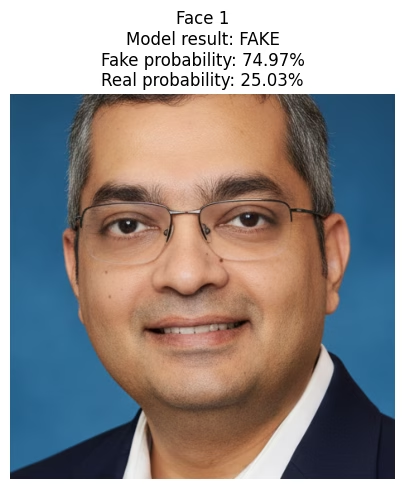
Step 4 — Detecting Deepfakes
Now the pipeline uses a pretrained computer vision model.
The model estimates:
- Probability the image is real
- Probability the image is AI-generated
- Confidence score
- Consistency across multiple detected faces
This provides one important piece of evidence—but it is not the final verdict.
A single model can make mistakes, especially with new or unseen manipulation techniques.
Step 5 — Digital Image Forensics
Many image edits leave behind subtle traces that humans cannot see.
The pipeline performs several forensic checks, including:
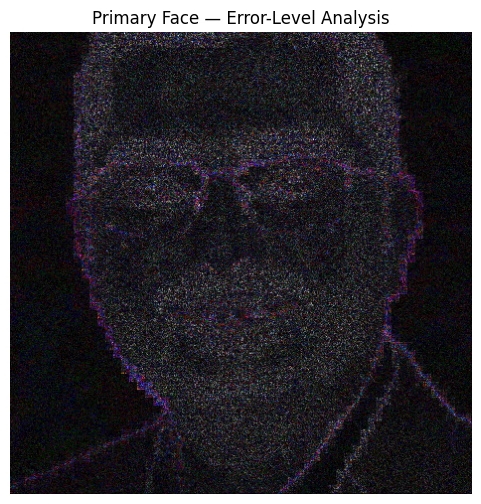
Error Level Analysis (ELA)
ELA reveals areas of an image that have been compressed differently.
Unexpected compression patterns can indicate that parts of the image were edited after the original photo was saved.
JPEG Recompression Analysis
Saving an edited JPEG image often introduces compression inconsistencies.
These hidden artifacts can provide clues about image manipulation.
Noise Analysis
Every camera sensor produces a unique pattern of tiny random variations called image noise.
If one region has noticeably different noise characteristics, it may have been inserted from another source or generated synthetically.
Understanding Image Forensics
Imagine repainting one corner of an old wall.
Even if you match the color perfectly, the texture often looks slightly different.
Image forensics searches for these tiny inconsistencies that are invisible to the naked eye.
Step 6 — Looking Beyond What Humans Can See
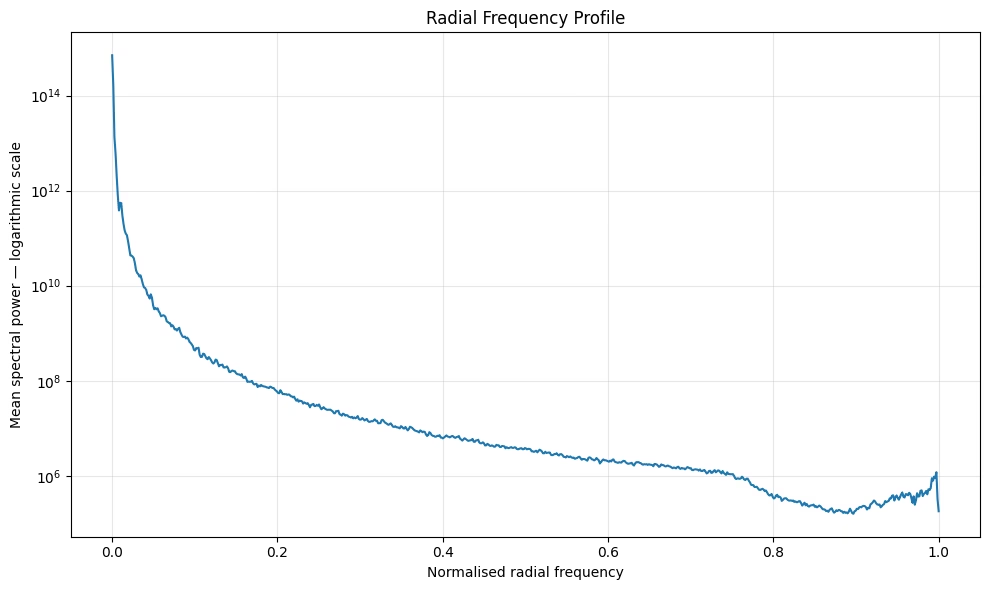
The pipeline transforms the image into the frequency domain using a Fast Fourier Transform (FFT).
Instead of analyzing pixels directly, it examines repeating patterns and textures.
It measures:
- Low-frequency energy
- Mid-frequency energy
- High-frequency energy
- Spectral entropy
- Directional energy
- Radial frequency profile
- Isolated spectral peaks
Some AI-generated images leave behind unusual frequency signatures that can help distinguish them from authentic photographs.
Understanding FFT
Imagine listening to a song.
You hear one piece of music.
But an audio engineer can separate that song into bass, drums, vocals, and guitars.
FFT performs a similar task for images by breaking them into different frequency components, revealing patterns that are difficult to detect in the original pixels.
Step 7 — Inspecting Metadata
Every photograph carries contextual information about its origin.
The pipeline checks:
- Camera model
- Lens information
- Capture timestamps
- Editing software
- Image dimensions
- File hashes
- EXIF metadata
- Metadata consistency
Missing or inconsistent metadata doesn’t prove an image is fake, but it adds another valuable clue.
Step 8 — Evidence Fusion
This is the most important part of the system.
Instead of trusting one detector, the pipeline combines evidence from multiple independent sources:
- Deepfake classifier
- Image forensics
- FFT analysis
- Metadata
- Image quality
- Face analysis
Each source contributes to a weighted risk score based on its reliability and availability.
This mirrors how human investigators build confidence by corroborating multiple clues.
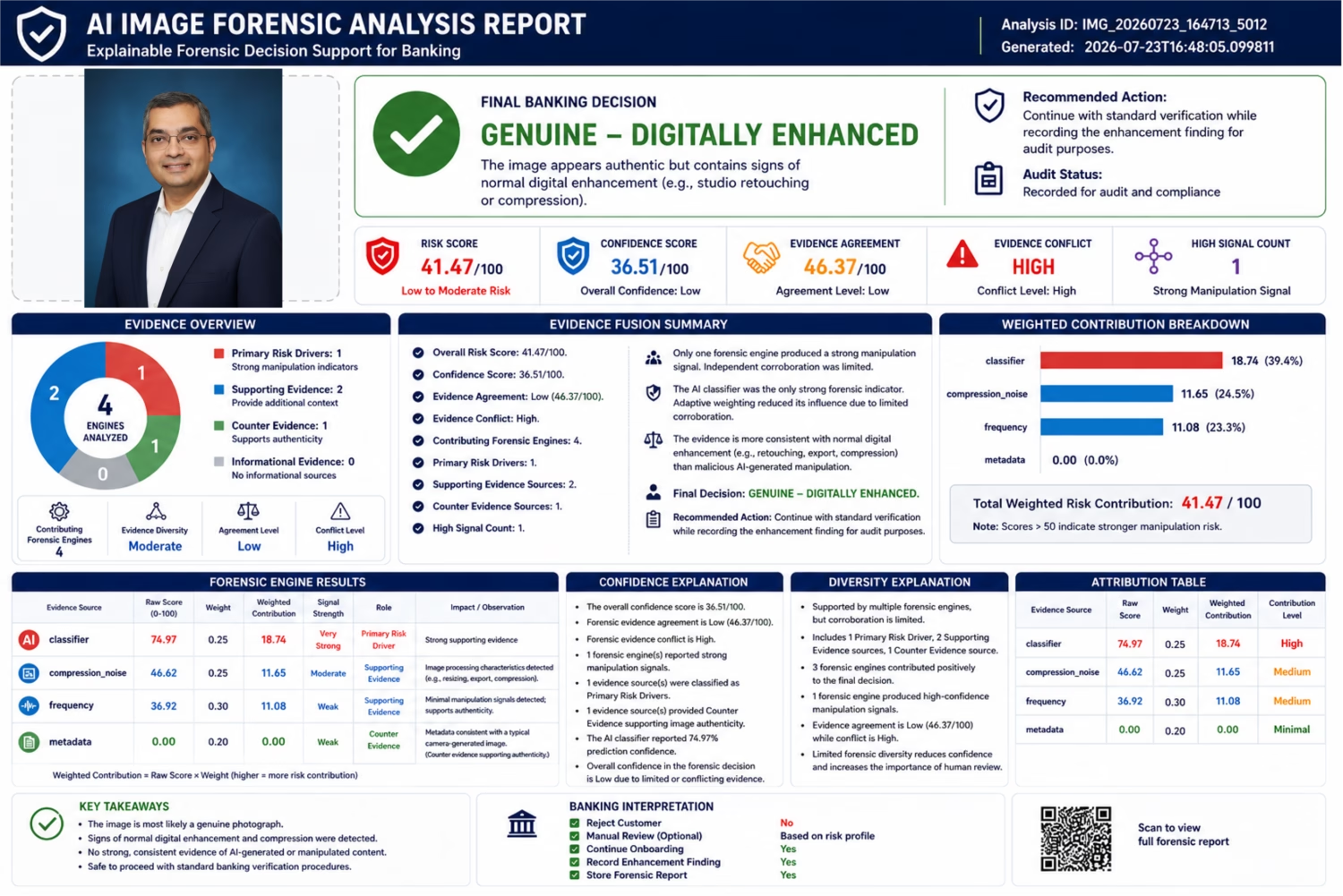
================================================================================
IMAGE FORENSIC ASSESSMENT
================================================================================

Final Decision
--------------
GENUINE - DIGITALLY ENHANCED

Overall Risk
------------
41.47/100
(Low Risk)

Overall Confidence
------------------
36.51/100
(Low Confidence)

Evidence Agreement
------------------
Low
(46.37/100)

Evidence Conflict
-----------------
High

Decision Rationale
------------------
Classifier indicates possible manipulation, but supporting forensic evidence is weak. Image likely contains professional editing.

Evidence Fusion Summary
-----------------------

• Overall Risk Score: 41.47/100.
• Confidence Score: 36.51/100.
• Evidence Agreement: Low (46.37/100).
• Evidence Conflict: High..
• Contributing Forensic Engines: 4.
• Primary Risk Drivers: 0.
• Supporting Evidence Sources: 0.
• Counter Evidence Sources: 0.
• High Signal Count: 1.
• Only one forensic engine produced a strong manipulation signal. Independent corroboration was limited.
• The AI classifier was the only strong forensic indicator. Adaptive evidence weighting reduced its influence because other forensic engines did not provide sufficient corroboration.
• The evidence is more consistent with normal digital enhancement such as professional retouching, export or image compression than malicious AI-generated manipulation.
• Final Banking Decision: GENUINE - DIGITALLY ENHANCED.
• Recommended Action: The image appears authentic but contains signs of normal digital enhancement (for example, studio retouching or compression). Continue with standard verification while recording the enhancement finding for audit purposes..

Primary Risk Drivers
--------------------

• classifier (Very Strong, Contribution: 18.74)

Counter Evidence
----------------

• metadata

Recommended Action
------------------
The image appears authentic but contains signs of normal digital enhancement (for example, studio retouching or compression). Continue with standard verification while recording the enhancement finding for audit purposes.

================================================================================
Step 9 — Rule-Based Decision Engine
Rather than allowing one model to decide the outcome, explicit business rules produce the final assessment.
Possible outcomes include:
- Genuine
- Genuine – Digitally Enhanced
- Suspicious – Manual Review
- High Confidence AI Manipulation
This ensures decisions remain transparent, repeatable, and aligned with organizational policies.
Step 10 — Explainability
One of the biggest challenges in AI is trust.
Instead of simply saying, “This image is fake,” the system explains why.
The report highlights:
- Primary risk drivers
- Supporting evidence
- Contradictory evidence
- Detector contributions
- Confidence score
- Recommendations for analysts
This allows investigators to understand and verify the reasoning behind the result.
Step 11 — LLM-Powered Report Generation
A common misconception is that an LLM decides whether an image is fake.
In this pipeline, it does not.
The LLM acts like a technical writer rather than an investigator.
It converts validated findings into a standardized, human-readable forensic report.
To ensure reliability, the LLM is constrained to:
- Use only validated evidence
- Preserve numerical scores and decisions
- Avoid speculation
- Add no new facts
- Produce a consistent analyst report
This separation of responsibilities keeps the decision-making process transparent and auditable.
Real-World Applications
This type of forensic pipeline can be used in many industries:
- Journalism: Verify images before publication.
- Law Enforcement: Analyze digital evidence.
- Banking: Detect identity fraud.
- Insurance: Investigate manipulated claim photos.
- Social Media: Flag suspicious uploads.
- Cybersecurity: Investigate phishing and impersonation attacks.
- Government: Authenticate official digital records.
Limitations
No AI system can guarantee perfect accuracy.
Sophisticated deepfakes may evade current detectors, while legitimate images can occasionally trigger false alarms due to unusual editing or compression.
That’s why this pipeline emphasizes evidence fusion and manual review for ambiguous cases. It is designed to support human analysts, not replace them.
Key Takeaways
- Reliable AI systems combine multiple independent signals instead of relying on a single prediction.
- Digital image forensics includes computer vision, classical forensic techniques, metadata inspection, and explainable decision-making.
- Trustworthy AI explains its conclusions and quantifies uncertainty.
- LLMs are most valuable here as reporting assistants, not decision-makers.
- Human oversight remains essential for high-stakes investigations.
Next Project
In the next tutorial, we’ll extend this forensic system to video deepfake detection, where we’ll analyze facial movements, temporal consistency across frames, audio-visual synchronization, and cross-frame evidence fusion to detect AI-generated videos.
Want to learn more about everyday use of AI?
Discover more from Debabrata Pruseth
Subscribe to get the latest posts sent to your email.