AI Engineering

AI Engineering is a collection of practical AI projects, experiments, tutorials, and applied research notes focused on building and understanding real-world AI systems. This section covers applied machine learning, deep learning, foundation models, AI agents, and hands-on experimentation with modern AI tools.

The goal is to make AI engineering easier to understand through concrete examples, beginner-friendly explanations, and practical implementation notes. These articles are written for AI learners, engineers, enterprise architects, researchers, and technology leaders who want to understand how AI systems are designed, tested, and applied in real-world scenarios.

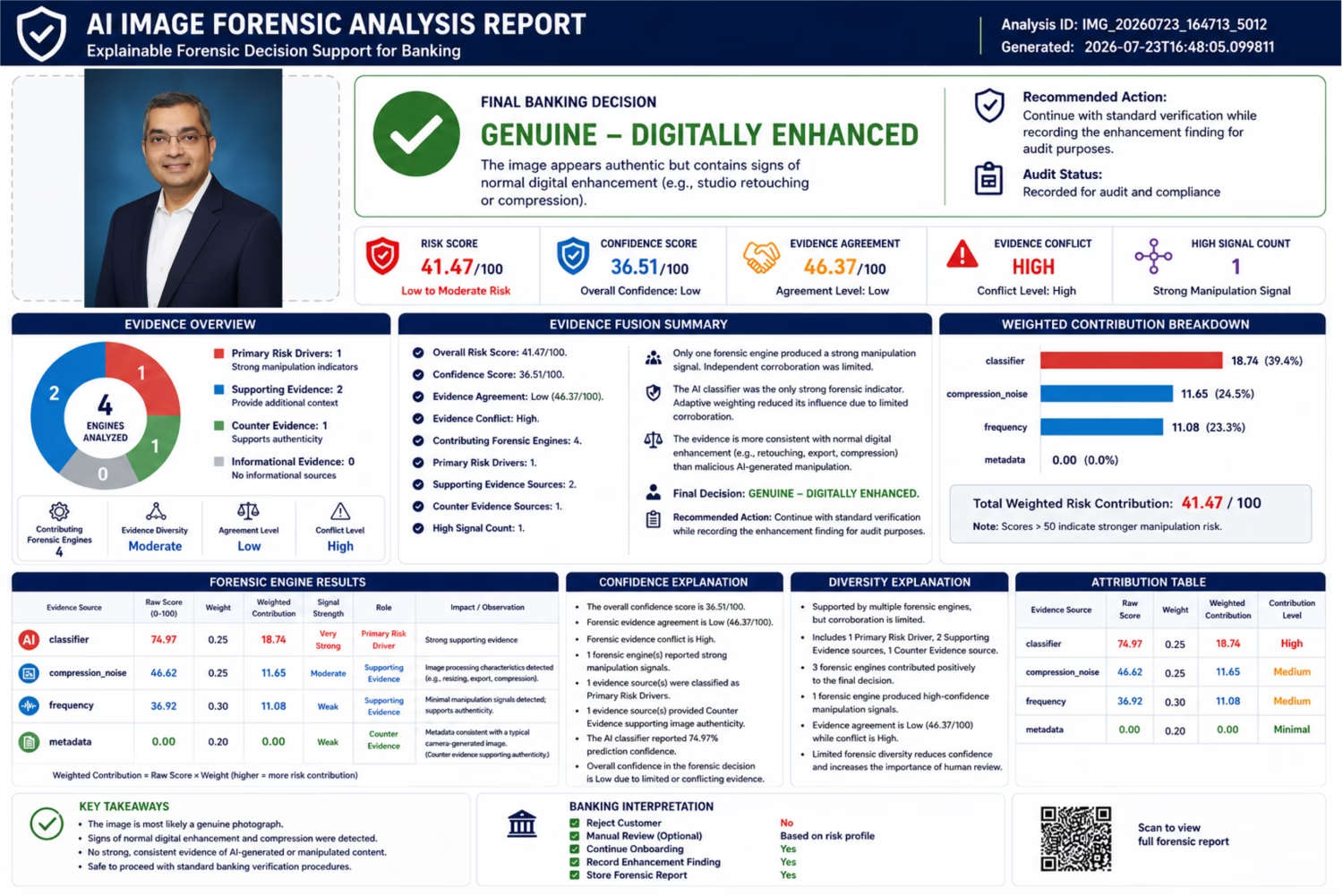
Build an AI Deepfake Image Detection System: A Beginner’s Guide to Multi-Evidence Digital Forensics

Learn how to build an AI-powered deepfake image detection system that combines computer vision, image forensics, metadata analysis, and explainable AI to detect manipulated images with confidence.

Build an AI Deepfake Image Detection System: A Beginner’s Guide to Multi-Evidence Digital Forensics Read More »

Build an AI-Powered Market Risk Control Cockpit with Python and Generative AI

Banks process enormous volumes of market data every day—but one stale or incorrect price can affect valuations, P&L, risk metrics, and regulatory reporting.

In this hands-on Python project, we build an AI-powered Market Risk Control Cockpit that combines deterministic rules, Isolation Forest, portfolio exposure, scenario analysis, Streamlit, and generative AI.

The goal is not to replace market-risk analysts.

It is to help them find the alerts that matter.

Build an AI-Powered Market Risk Control Cockpit with Python and Generative AI Read More »

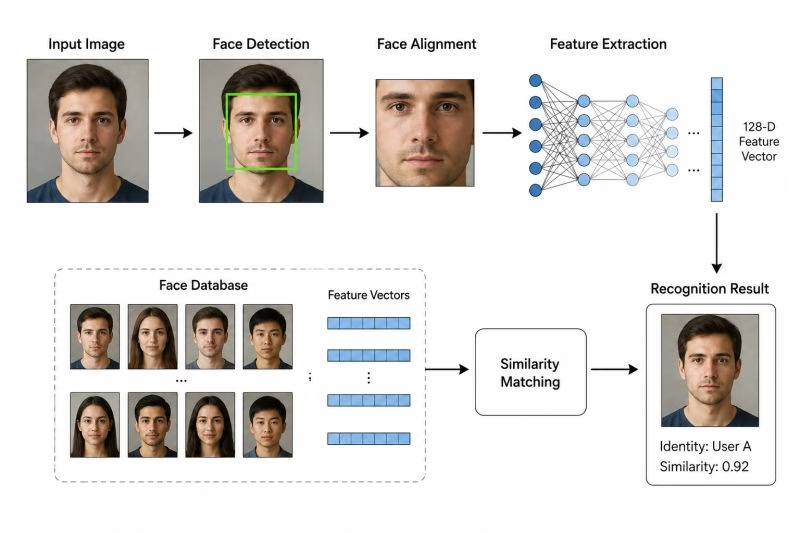
Build a Face Recognition System with Python and InsightFace

Can AI tell whether two photos belong to the same person?

In this week’s hands-on AI project, you’ll build a complete face recognition system using Python and InsightFace. Learn how AI detects faces, generates facial embeddings, compares identities, and ranks the closest matches—all while understanding the concepts behind the code. Perfect for beginners looking to build a real-world computer vision project.

Build a Face Recognition System with Python and InsightFace Read More »

From Simulation to Prediction: Learning Fluid Dynamics with AI

Can an AI predict how fluid moves?

In this piece, I explore how a physics foundation model—WALRUS—learns to forecast the evolution of a heated fluid system. Instead of solving equations, the model observes patterns and generates its own version of the future. The result is a striking simulation that reveals both the power and the limits of AI in modeling the physical world.

From Simulation to Prediction: Learning Fluid Dynamics with AI Read More »

AI-Assisted Protein Analysis: From Sequence to Drug-Binding Hypothesis

Can AI help us understand how medicines interact with the body?
In this edition, I explore a beginner-friendly experiment where I used AI tools like AlphaFold and AutoDock Vina to go from a protein sequence to a plausible drug-binding hypothesis—all on a laptop. A simple walkthrough, even if you’re new to biology.

AI-Assisted Protein Analysis: From Sequence to Drug-Binding Hypothesis Read More »

Building a Persona-Driven Survey Engine Using AI

What if you could test your product idea before having real users?
In this post, I show how to use AI personas to build a synthetic focus group—generate surveys, simulate responses, and uncover insights early.

Building a Persona-Driven Survey Engine Using AI Read More »

Earth, in a Bottle. A Robot, with Imagination. And an AI That “Knows Everything.”

Earth Models, World Models, and Global Models are three fast-growing “families” of AI systems that are often mentioned together—but they solve very different problems. This blog provides an accessible, research-oriented map of the landscape for readers who are new to AI (and for technical readers entering the field).

Earth, in a Bottle. A Robot, with Imagination. And an AI That “Knows Everything.” Read More »

Deep Learning Concepts for Beginners : Cooking Pasta Analogy

What does learning deep learning have in common with cooking pasta?

More than you might think.

In this article, I explain deep learning concepts for beginners using the familiar process of learning to cook pasta—preparing ingredients, tasting, adjusting, and improving with every attempt. It’s a simple, intuitive way to understand how neural networks train, make mistakes, and get better over time—without heavy math or jargon.

Deep Learning Concepts for Beginners : Cooking Pasta Analogy Read More »

Deep Learning Concepts for Beginners : Basketball Player Analogy

What if understanding neural networks felt as natural as watching someone learn basketball?

In this short read, I explain how a neural network learns—using the simple, familiar journey of a player practicing shots, missing, adjusting, and improving. No heavy math. Just intuition, clarity, and a fresh way to see how AI actually learns.

Deep Learning Concepts for Beginners : Basketball Player Analogy Read More »

A Beginner-Friendly Guide to Privacy in AI

Privacy in AI

What happens when your AI model is accurate… but not private?
Trust disappears.
In this blog, I show you how to build privacy into your models using simple concepts like epsilon, clipping, and federated learning. We even run 60 privacy experiments to find the perfect balance. A great read for students and young professionals exploring responsible AI.

A Beginner-Friendly Guide to Privacy in AI Read More »

Scroll to Top