AI Engineering

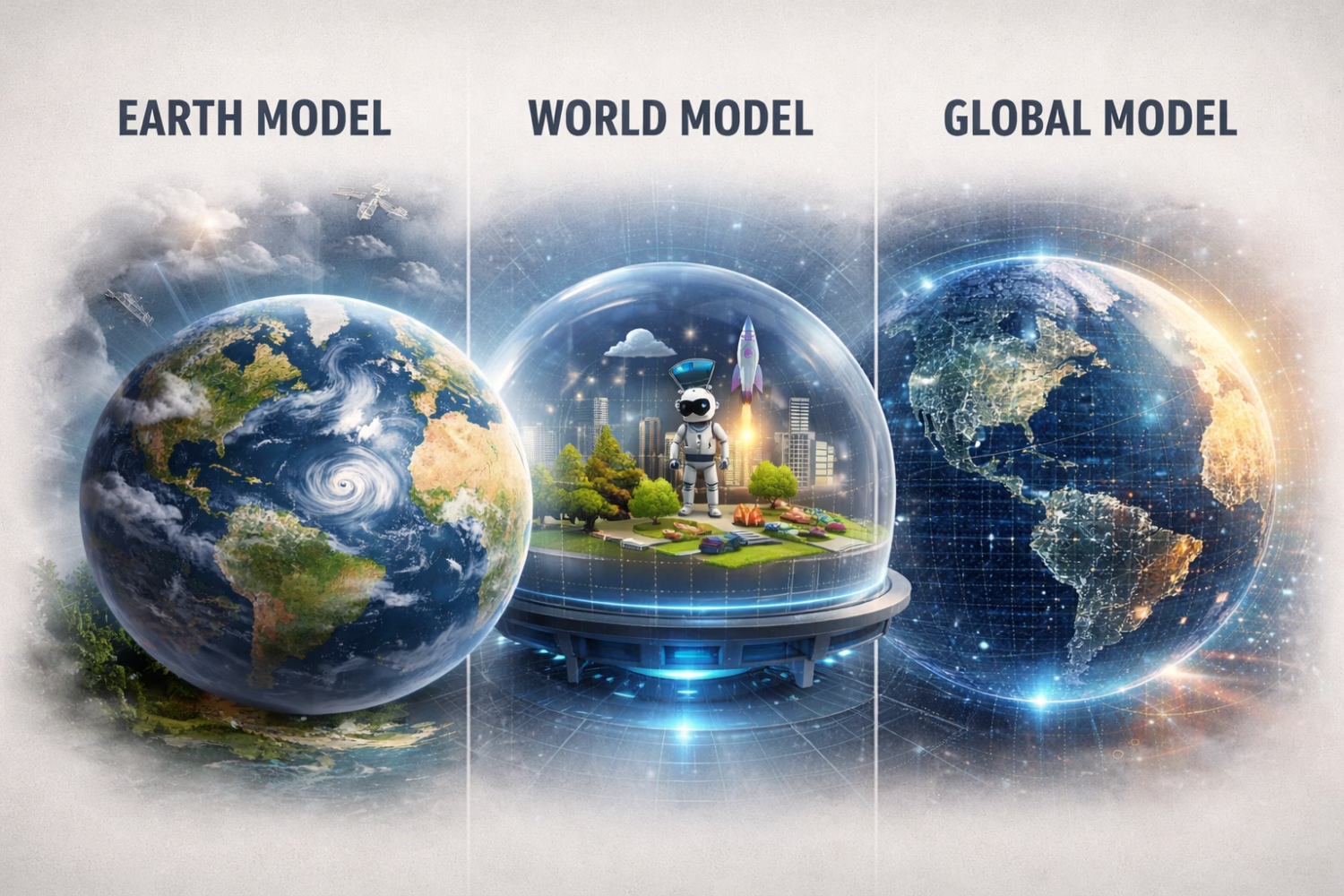
Earth, in a Bottle. A Robot, with Imagination. And an AI That “Knows Everything.”

Earth Model vs Global Model vs World Model

Earth Models, World Models, and Global Models are three fast-growing “families” of AI systems that are often mentioned together—but they solve very different problems. This blog provides an accessible, research-oriented map of the landscape for readers who are new to AI (and for technical readers entering the field).

Earth, in a Bottle. A Robot, with Imagination. And an AI That “Knows Everything.” Read More »

Deep Learning Concepts for Beginners Explained Through a Cooking Pasta Analogy (No Math Required)

What does learning deep learning have in common with cooking pasta?

More than you might think.

In this article, I explain deep learning concepts for beginners using the familiar process of learning to cook pasta—preparing ingredients, tasting, adjusting, and improving with every attempt. It’s a simple, intuitive way to understand how neural networks train, make mistakes, and get better over time—without heavy math or jargon.

Deep Learning Concepts for Beginners Explained Through a Cooking Pasta Analogy (No Math Required) Read More »

Deep Learning Concepts for Beginners Explained Using a Basketball Player Analogy (No Math Required)

What if understanding neural networks felt as natural as watching someone learn basketball?

In this short read, I explain how a neural network learns—using the simple, familiar journey of a player practicing shots, missing, adjusting, and improving. No heavy math. Just intuition, clarity, and a fresh way to see how AI actually learns.

Deep Learning Concepts for Beginners Explained Using a Basketball Player Analogy (No Math Required) Read More »

A Beginner-Friendly Guide to Privacy in AI

Privacy in AI

What happens when your AI model is accurate… but not private?
Trust disappears.
In this blog, I show you how to build privacy into your models using simple concepts like epsilon, clipping, and federated learning. We even run 60 privacy experiments to find the perfect balance. A great read for students and young professionals exploring responsible AI.

A Beginner-Friendly Guide to Privacy in AI Read More »

A Beginner-Friendly Guide to Explainable AI (XAI)

Curious how AI models make decisions—or what goes on inside their “black box”?

In my latest blog, I break down explainable AI with hands-on Python examples, using real tools like SHAP, LIME, ELI5, and DALEX. Whether you’re a student, educator, or just passionate about responsible tech, this guide will help you see (and trust!) how machine learning models “show their work.”

Discover:
– What “explainability” really means
– How to interpret model explanations and plots
– Why transparency and fairness in AI matter

A Beginner-Friendly Guide to Explainable AI (XAI) Read More »

How to Detect Hidden Bias in Your ML Model — A Step-by-Step Tutorial 

Ever wondered how AI decides who gets hired or approved for a loan?
Spoiler: it sometimes inherits our biases.
In my latest blog, I uncover how bias sneaks into machine learning—and how we can fix it to make AI fairer for everyone.

👉 Read the full story: The Hidden Bias in Machines

How to Detect Hidden Bias in Your ML Model — A Step-by-Step Tutorial  Read More »

A Beginner’s Guide to Time Series Modeling

Ever wondered how AI predicts tomorrow’s weather, stock prices, or even your heart rate? In my latest blog, I break down how machines learn from the past to predict the future — exploring trends, seasonality, and hidden patterns in data. You’ll discover the evolution from classic models like ARIMA and Random Forests to modern deep learning architectures such as LSTMs and Transformers, and even the rise of foundation models like TimeGPT and TimesFM. Perfect for beginners curious about how AI understands time and turns data into foresight.

A Beginner’s Guide to Time Series Modeling Read More »

Transfer Learning for Multimodal Models

Ever searched for a product just by uploading a picture — and instantly found what you wanted?
That’s multimodal AI at work. These models combine images with text metadata like titles, brands, and descriptions to make search and recommendations smarter and more human-like.

Now imagine a radiologist’s assistant: a model that looks at CT scans and reads clinical notes — highlighting suspicious regions or suggesting possible conditions. Tools like MedCLIP and other multimodal models are already transforming healthcare.

But here’s the fascinating part — researchers don’t build these systems from scratch. They reuse existing models that already know how to read text and interpret images, then fine-tune them for specific domains.

Welcome to the world of multimodal transfer learning — where AI learns to connect what it sees and what it reads.
In this blog, we’ll break down how it works, with simple explanations and real-world examples that uncover the magic behind this powerful technique.

Transfer Learning for Multimodal Models Read More »

Transfer Learning for Vision

Ever wondered how AI can detect cancer from scans or spot heart disease in an X-ray — without being trained on millions of medical images?
Here’s the secret: Transfer Learning.

Instead of building models from scratch, researchers take pretrained vision models — already trained to recognize everyday objects like cats, buses, and trees — and teach them new skills like reading X-rays or identifying plant diseases.

This approach saves time, data, and computing power, yet delivers the same or even better accuracy.

In this blog, we’ll explore how transfer learning for vision works, the frameworks behind it, and why it’s revolutionizing fields from healthcare to agriculture.

Transfer Learning for Vision Read More »

Transfer Learning for NLP

Transfer Learning in Natural Language Processing (NLP)

Ever wondered how AI learns new languages so quickly — or how ChatGPT seems to instantly “get” what you’re saying?
That’s the power of transfer learning in Natural Language Processing (NLP) — where AI learns language the way we do: by reading, predicting, and reusing patterns from billions of words it’s already trained on.

In this post, we’ll explore how pretrained language models like BERT and GPT are used to solve real-world problems — with less data, lower compute, and faster results.

Transfer Learning for NLP Read More »

Scroll to Top