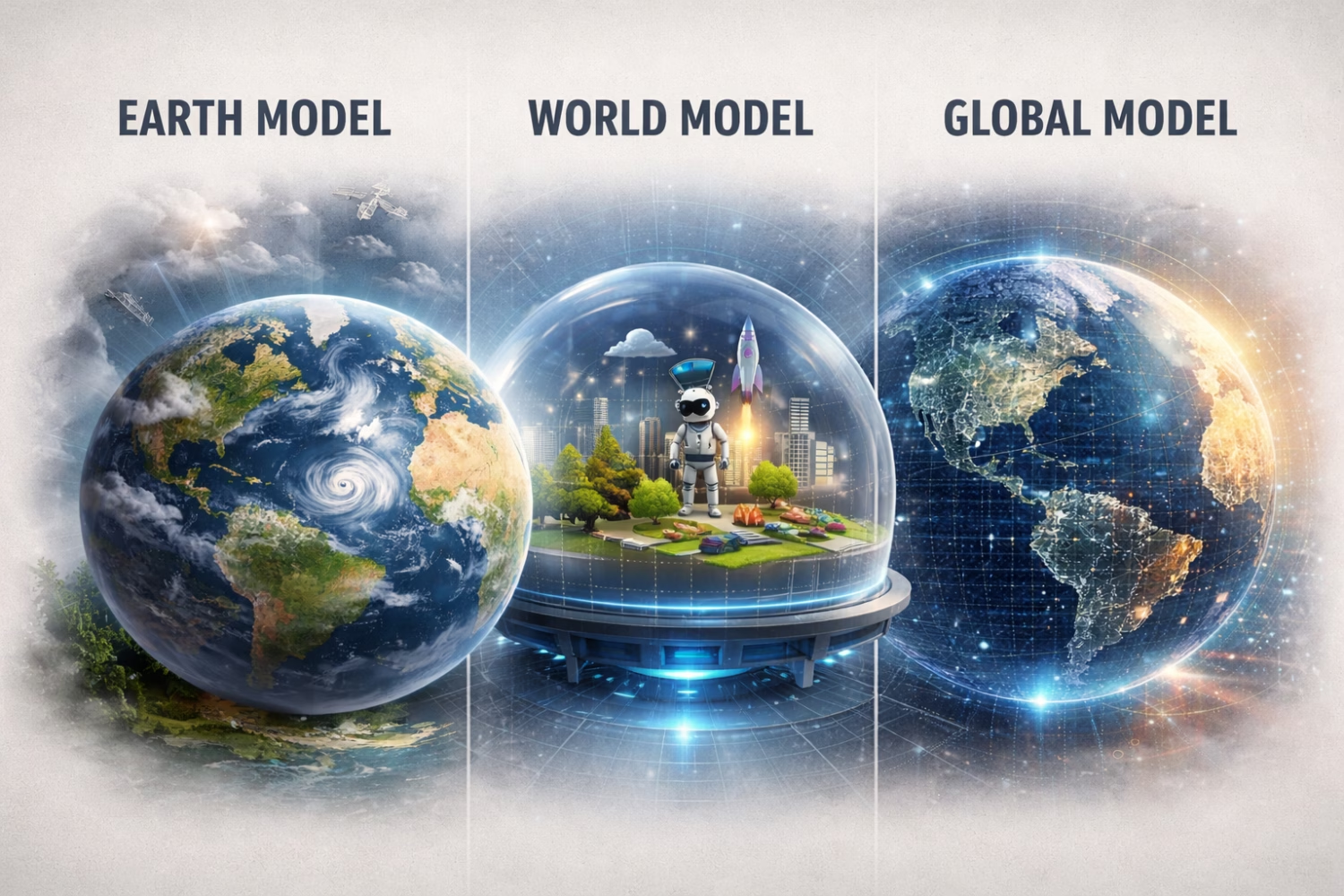
Earth Models, World Models, and Global Models are three fast-growing “families” of AI systems that are often mentioned together—but they solve very different problems. This blog provides an accessible, research-oriented map of the landscape for readers who are new to AI (and for technical readers entering the field). We introduce a simple mental model: Global Models are AI polymaths trained on broad internet-scale data; Earth Models are digital twins of our planet trained on weather, climate, and Earth-observation data; and World Models are imagination engines that let agents simulate the consequences of actions before acting. Using recent literature, we explain what each model type is trying to represent, why evaluation is hard (e.g., physical consistency and long-horizon stability), and how subcategories such as surrogate models, neural simulators, hybrid physics–AI, and foundation/embedding models fit into the picture. We also highlight a compelling trend: the next wave of AI systems will likely be composable stacks, where a global model reasons and communicates, a world model plans via rollouts, and an earth model forecasts real-world outcomes—unlocking practical applications from climate risk and disaster response to robotics and autonomy. The goal is to help you quickly build correct intuition, learn the key terminology, and know which papers and model families to follow next.
Earth Models: Digital Twins of Our Planet
Earth models serve as digital replicas of our planet, capturing climate and environmental systems in silico. Earth models use AI and physics to simulate Earth’s climate, weather, and ecosystems – essentially digital twins of our planet. They integrate vast geophysical data to mirror real-world processes (atmospheric dynamics, ocean currents, water cycles, etc.), enabling scientists to predict and analyze environmental changes with high fidelity. For example, state-of-the-art Earth models can now run at near 1-kilometer resolution, combining short-term weather and long-term climate processes – a feat recently dubbed the “holy grail” of climate modeling . These models track “fast” processes like weather and “slow” processes like carbon cycles in tandem, often requiring supercomputers and advanced software optimizations .
Real-World Examples & Use Cases: Earth models underpin weather forecasts, climate change projections, and disaster simulations. One landmark effort is the European Destination Earth initiative (DestinE), which aims to create an interactive Earth digital twin for policymakers . In practice, climate agencies and tech companies use Earth models to test “what-if” scenarios (e.g. how cutting emissions might alter future warming) and to inform infrastructure planning. High-resolution models have recently simulated global weather patterns with unprecedented detail – for instance, Klocke et al. (2025) demonstrated a global climate model at 1.25 km resolution, allowing more accurate representation of extreme weather events . These advances help predict heat waves, hurricanes, and droughts more reliably, informing early warning systems and climate adaptation strategies.
Recent Research Highlights (2024–2025): The past two years saw AI-driven Earth models leap forward. AI climate emulators – neural networks trained to mimic expensive physics models – are dramatically speeding up simulations. Brenowitz et al. (2025) introduced cBottle, a diffusion-based “generative foundation model” for climate that can emulate global weather at 5 km resolution . Unlike traditional step-by-step simulators, cBottle draws full atmospheric states from learned distributions, enabling thousands-fold faster generation of plausible climate outcomes (e.g. targeted extreme weather scenarios) without sacrificing accuracy . Meanwhile, Schreck et al. (2025) showed that AI-based weather models can outperform one of the world’s best numerical forecasting systems (ECMWF’s IFS) on key global metrics, while using orders of magnitude less computation . This was achieved via the CREDIT framework (Community Research Earth Digital Intelligence Twin), which facilitated training novel architectures like WXFormer – a vision-transformer-based forecast model that beat IFS in 10-day prediction skill . Researchers are also blending physics with AI: hybrid models can enforce known physical laws (e.g. energy conservation) inside neural networks to improve realism and trustworthiness of Earth simulations .
Open-Source and Industry Models: Importantly, many Earth models are openly shared, reflecting the global stakes of climate research. The Allen Institute for AI’s OlmoEarth (2025) is an open-source family of Earth observation foundation models, trained on terabytes of satellite imagery to extract insights on deforestation, agriculture, and more . OlmoEarth’s variants (from 1.4M to 300M parameters) achieved state-of-the-art performance on tasks like mapping crops in Africa, detecting wildfires, and classifying ecosystems – outperforming other industry models like Meta’s DINOv3 and IBM’s Prithvi on dozens of benchmarks . On the industry side, NVIDIA’s Earth-2 platform leverages GPU-accelerated AI to build interactive climate digital twins. Its cBottle model (mentioned above) compresses 50 years of high-res climate data into a queryable AI system, enabling users to explore scenarios (e.g. “generate an extreme rainfall event over Mumbai”) on demand . Max Planck Institute researchers used Earth-2 to run the first-ever global climate simulations at 1 km scale, demonstrating how AI plus supercomputing can push the frontiers of resolution . Other examples include Google’s GraphCast (an AI weather model using graph neural networks) and Microsoft’s ClimaX (deep learning for weather downscaling), both accelerating computations that once took hours into mere seconds.
Subcategories: Earth models span several subtypes. Earth system models generally refer to comprehensive simulators of the entire climate (atmosphere, ocean, land, ice, biosphere), often used for climate change projections. Within this, global climate models (GCMs) focus on physical climate dynamics (e.g. general circulation models of atmosphere/ocean). There are also regional models for finer local detail, and Earth Models of Intermediate Complexity (EMICs) that simplify some processes to explore long-term dynamics. In the AI era, new subcategories have emerged: emulators or surrogate models mimic the outputs of traditional simulators at a fraction of the cost; downscaling models increase the resolution of coarse climate data (often using super-resolution techniques ); and hybrid models combine neural nets with physical equations (for example, learning the unresolved physics like cloud formation while embedding conservation laws for reliability). In Earth observation, we also see foundation models (like OlmoEarth) that learn representations from remote sensing data, which can be fine-tuned for tasks like habitat mapping or disaster damage assessment.
Forward-Looking Applications and Trends: Earth models are becoming indispensable tools for addressing global challenges. As climate change accelerates, these AI-driven twins of Earth will help explore “what-if” policies (e.g. the impact of cutting emissions or deploying geoengineering) in a virtual setting before we experience them in reality . There’s a push toward interactive Earth models – imagine querying a climate AI with natural language: “If a major volcanic eruption happens next year, how might it affect global temperature?” and getting an answer with visualizations. Companies like NVIDIA and Microsoft are investing in cloud platforms to make such interfaces accessible, hoping to democratize climate insights for urban planners, farmers, and policymakers. Real-time Earth monitoring is another emerging trend: future Earth models might continuously assimilate sensor data (satellite feeds, IoT weather stations) to maintain a live mirror of planetary conditions. This could enable AI to spot anomalies (like an abrupt spike in Arctic warming) and suggest rapid responses. Moreover, Earth models are expanding to integrate human and economic systems (sometimes called “world-Earth models” in sustainability science ). By coupling climate models with models of energy, agriculture, or health outcomes, AI can help optimize strategies for sustainable development, balancing environmental and societal needs on a global scale. In short, Earth models are evolving from pure climate science tools into decision-support engines for humanity’s biggest problems – a trend likely to continue as data grows and AI techniques improve.
World Models: Imagination Engines for AI Agents
World models give AI a kind of “imagination” – a learned internal sandbox to predict outcomes of actions before trying them in reality. World models in AI refer to an agent’s internal model of the world – essentially an “imagination engine” that lets an AI simulate possible futures and reason about consequences. Instead of reacting reflexively to inputs, an AI with a world model can ask “What if I do X?” and internally roll out a prediction without actually taking action. In other words, the world model is a mental simulator of the agent’s environment. It encodes the environment’s dynamics (how things change in response to actions) and latent state (the underlying situation), enabling counterfactual reasoning. As one Quanta article analogized, a world model is like a “computational snow globe – a miniature representation of reality” inside the AI’s head . This concept has deep roots: cognitive scientists as far back as Kenneth Craik in 1943 suggested organisms carry “small-scale models” of external reality to foresee outcomes and act safely . Modern AI research is reviving this idea, as many believe world models are essential for truly smart, goal-directed AI .
Real-World Examples & Use Cases: World models are key in robotics, autonomous vehicles, reinforcement learning (RL), and any AI that interacts with the physical world. Consider a self-driving car approaching an intersection – a world-modeling AI can imagine different scenarios (if a pedestrian suddenly crosses, if the car takes a left turn, etc.) and choose a safe action by essentially “visualizing the future.” In robotics, world models let machines predict the outcomes of manipulations: e.g. a robot arm with a learned world model can foresee that pushing a glass too fast might tip it over, and thus adjust its force. One famous early example was the 2018 “World Models” experiment by Ha and Schmidhuber, where an agent learned a compact internal model of a car-racing game. It then dreamed trajectories in its latent space to plan driving actions, achieving high scores with far fewer trials than a model-free agent. In gaming and simulation, world models allow AI to plan moves by internally simulating the game’s physics and rules. They also power model-based reinforcement learning algorithms (like DeepMind’s Dreamer and MuZero), which have achieved sample-efficient learning in complex environments by planning in the model’s “imagination” rather than random trial-and-error. Beyond games, world models are being used in AR/VR: for instance, an AR system can maintain a 4D world model (3D space + time) of a room so that virtual objects stably interact with real ones (ensuring, say, a digital character walks behind a real couch consistently) . In summary, any AI agent that needs to navigate, manipulate, or understand an environment can benefit from a world model to predict physics, agent behaviors, or even the evolution of scenes over time.
Recent Research Highlights (2024–2025): World modeling has become one of the hottest frontiers in AI research, with significant breakthroughs in the last two years. A noteworthy trend is combining world models with powerful generative architectures (like large language models and diffusion models) to create general, interactive simulations. Xiang et al. (2025) introduced PAN, a world model that can simulate rich, long-horizon videos conditioned on actions and language commands . PAN employs a Generative Latent Prediction (GLP) architecture: it uses a large language model as an “internal narrator” that evolves the latent state (keeping track of what’s in the scene and how it’s changing), and a diffusion video decoder to translate those states into high-fidelity visuals . This lets an agent not only imagine what will happen, but also see it in a realistic way – effectively unifying latent reasoning (imagination) with perceptual realism (visualizing the imagined world) . Trained on diverse video + action data, PAN can handle instructions like “drive through a snowy forest then turn onto the highway,” producing a coherent predicted video of the scenario step by step. It outperforms previous video generators on metrics of causal consistency and long-term stability, marking a step toward “general world models” that work across domains .
Another cutting-edge result comes from the 2025 preprint TeleWorld by Zhang et al. (2025), which showed that guiding video generation with a continuously updated 4D world model (space + time) greatly improves temporal consistency . In their demonstration, a model with a 4D world state avoided the infamous glitches of typical video AIs (like objects changing appearance or disappearing) – e.g. ensuring a dog’s collar doesn’t vanish when it runs behind a sofa, and the sofa doesn’t morph into a different color later . This highlights how having an explicit scene representation that persists and updates over time can solve the consistency problems purely generative models face. Similarly, in robotics, researchers are integrating world models for counterfactual reasoning . The broader research community has also produced extensive surveys – e.g. “A Comprehensive Survey of World Models for Embodied AI” (Xiao et al., 2025) – reflecting the maturity of the field and summarizing dozens of approaches, from model-based RL algorithms to world models in language-assisted settings.
Industry labs are racing to apply these advances. Notably, NVIDIA in 2025 announced its Cosmos world foundation models, aimed at giving robots and autonomous vehicles a strong predictive world model. These models (part of NVIDIA’s Isaac platform) can generate realistic physics simulations and sensor outputs from various inputs (like turning LiDAR scans into virtual scenes) to help train and test robots in simulation. NVIDIA CEO Jensen Huang stated, “Just as large language models revolutionized generative and agentic AI, Cosmos world models are a breakthrough for physical AI,” underscoring the significance of world models for robots that must reason in the real world . Early adopters like Agile Robotics and Waymo are using such models to vastly expand their training data via simulated scenarios, effectively imagining countless edge cases (e.g. unusual pedestrian behaviors, rare road conditions) to make autonomous systems safer . Another example, startup Wayve released GAIA-1 (2023), a driving world model that generates realistic video rollouts of traffic scenarios from text descriptions, to evaluate self-driving car decision-making. All these efforts point toward a common goal: endowing AI agents with an “inner sandbox” where they can practice and reason before acting for real.
Analogy & Core Idea: To put it plainly, world models endow AI agents with imagination. Just as a human can mentally simulate “If I step on this icy patch, I might slip” without actually doing it, an AI’s world model lets it anticipate outcomes without trial-and-error in reality. A recent description by the PAN researchers captures this well: “most [generative AI] systems paint pictures…they predict frames, not the evolving world itself. That’s what a world model is meant to do: imagine, predict, and reason about how the world evolves when you intervene.” . Unlike a video generator that produces a fixed clip given a prompt, a world model maintains an evolving state of the world that persists and responds to the agent’s choices. This notion of a persistent state is crucial for causal reasoning and planning. Without it, AI systems are prone to continuity errors or overly reactive behavior (as we see with some image/video AIs or chatbots that lack memory of previous context). With a world model, an AI has a “mental model” of its environment that it continuously updates – much like our own cognitive map of the world – which it uses to evaluate options.
Subcategories: World models come in many flavors, often tailored to the domain or approach:
- Dynamics Models vs. Reward Models: In reinforcement learning, a dynamics model predicts the next state given the current state and action (essentially modeling the environment’s physics or rules), while a reward model predicts the expected reward or outcome value of a state/action. World models usually focus on dynamics (the environment simulator), though some approaches learn a combined model that also predicts rewards and even observations.
- Explicit vs. Implicit World Models: Some AI systems have an explicit world model module (e.g. a learned physics simulator) that is separate from the policy. Other times, the world model is implicit or embedded – for example, some argue large language models have implicit world knowledge from text training, but they lack a clearly defined, updatable world state . New research tries to give LLMs an explicit world memory (e.g. a stored scene model) so that they can reason about physical events more reliably.
- Latent-Space Models vs. Grounded Models: World models like PAN operate in a latent space – they don’t predict every pixel of the future explicitly at each step (which is hard), but rather encode the state in a compressed form and predict how that changes. Other approaches use grounded models that maintain states in interpretable forms (e.g. a 3D map of a room, or positions and velocities of objects). Latent models (often using VAEs, RNNs, Transformers) can be more scalable and capture uncertainty, but grounded models can be easier to interpret and enforce consistency.
- Single-Agent vs. Multi-Agent World Models: In multi-agent environments (like multi-robot systems or games with many agents), world models may include global state (the overall environment) as well as each agent’s local observations. For instance, a recent paper on multi-agent world modeling used a two-level approach: a global model that learns the joint dynamics of all agents and a set of local models for individual agent viewpoints . This helps in scenarios where cooperation or competition between agents is involved, ensuring the world model accounts for interactions.
- Hierarchical World Models: Complex worlds might be modeled at multiple levels of abstraction. A hierarchical world model could have a high-level module (with a coarse abstract state, like “Agent is exploring room 1” or “overall weather pattern”) and a low-level module (fine details, like “robot’s motor torques” or “raindrops in region”). Each level predicts and informs the other. This is analogous to how humans have high-level mental schemas and low-level sensory predictions working in tandem.
- Surrogate Simulators and Differentiable Simulators: Some world models are learned neural networks (surrogate simulators) trained on data from a physics engine or the real world; others incorporate differentiable physics engines so that the model can backpropagate through physical simulations. Differentiable physics (e.g. brax ) can serve as a form of world model that is partially analytic, partially learned.
Forward-Looking Applications and Trends: The push for world models is driven by the pursuit of more general and trustworthy AI. Researchers like LeCun, and Bengio (Turing Award laureates) argue that without world models, AI systems will keep making silly mistakes and be data-hungry . In the near future, we can expect AI agents that combine large knowledge models (like the next generation of GPT) with powerful world models, marrying abstract reasoning with grounded simulation. For example, an AI assistant might use an LLM to parse a task (“Cook a new recipe”) and a world model to safely control a home robot to execute it – mentally simulating each step to avoid accidents. Indeed, current LLMs lack real-time physical understanding, and achieving true AGI will require solving this by giving AI a way to continuously update its understanding of a changing world and act accordingly . We’re already seeing steps in that direction: research prototypes of embodied agents use language models for high-level decisions and world models for low-level planning, communicating in a loop.
Another trend is world models for safety and ethics: Before deploying an action, AI can simulate outcomes to check for undesirable consequences (much like Monte Carlo simulation in safety engineering). This could help AI avoid catastrophic mistakes by effectively asking “hmm, what might go wrong if I do this?” internally. World models also enable counterfactual and causal reasoning – for instance, AI scientists can use world models to run virtual experiments (e.g. “what if we intervene in this cellular process?” in a learned biology world model). In robotics, having a world model makes robots far more adaptive – they can train themselves through imagination (reducing the need for risky real-world trial-and-error) and handle novel situations by drawing on learned physics. There’s also excitement about world models in creative AI: imagine storytelling AIs that keep a coherent simulated world state so that narratives are consistent, or game AIs that can generate new levels/environments on the fly with built-in physics that players find believable and fun.
In summary, world models are about giving AI a model of the world – as simple as that sounds – which in practice is a profound shift from pattern recognition to model-based cognition. As these models improve, we move closer to AI that doesn’t just react to the world but understands and anticipates it, making AI behavior more consistent, generalizable, and safe. Researchers are fond of saying that world models let an AI “learn how the world works, not just how it looks” – much like how humans build internal models that allow us to navigate novel situations with common sense. The coming years will likely see world models integrated into many AI systems, from household robots to autonomous drones to intelligent tutoring systems (which simulate a student’s learning state). And as we develop better evaluation methods (e.g. testing an AI’s internal simulation fidelity ), we’ll better trust these imaginative machines. World models might well be the bridge that takes us from surface-level intelligence to deeper reasoning in artificial agents – a critical step on the path to more human-like AI.
Global Models: Broad Foundation Models with Worldwide Scope
Global models in AI refer to very large-scale models trained on globally diverse data, giving them a broad, generalist capability across many tasks and domains. These are often called foundation models – think of models like GPT-4 or PaLM that are pretrained on “the whole world’s knowledge” (massive text corpora, code, images, etc.) and can then be adapted to numerous applications. The term “global” here implies both the breadth of data (e.g. scraping text from many languages and cultures, or images from around the world) and the universality of function – a single model that can perform tasks as disparate as answering trivia, generating art, coding, or translating languages. In essence, global models are like AI generalists or encyclopedias, compared to specialist models that focus on one domain. An intuitive analogy is that a global foundation model is a “jack-of-all-trades AI brain” that has seen a bit of everything, from Shakespeare to Wikipedia to YouTube clips, and thus has a world-level understanding that can be applied flexibly.
For example, large language models (LLMs) like OpenAI’s GPT-4 were trained on text from essentially the entire internet – books, articles, websites in many languages – giving them a kind of global linguistic competency. They can answer questions about history, write code, summarize Chinese poetry, or have a conversation about virtually any topic. Similarly, multimodal models (which handle text, images, audio, etc.) are being trained on diverse media from across the world – one model might ingest satellite images, photographs, and text documents to answer queries like “find areas of deforestation in this region and describe the likely causes.” Because these models are so general, they can be fine-tuned or prompted to solve myriad tasks without training from scratch each time. In short, global models serve as foundational building blocks for AI applications everywhere, analogous to a globally-educated scholar who, with a bit of task-specific training, can tackle problems in medicine, law, finance, and beyond.
Real-World Examples & Use Cases: The impact of global foundation models is already evident in many areas of tech and daily life:
- Chatbots and Virtual Assistants: LLMs like GPT-4 (OpenAI) and Claude (Anthropic) power conversational agents that assist users worldwide. They answer customer service questions, act as writing aids, provide tutoring, and more – all by leveraging the general knowledge encoded in the global model. For instance, ChatGPT can help a student learn algebra, then switch to giving cooking tips, then draft a business email, all without task-specific reprogramming.
- Multilingual Translation & Information Access: Global models trained on multiple languages enable AI systems that break language barriers. Google’s PaLM 2 and Meta’s SeamlessM4T are examples of foundation models that handle translation and speech recognition across dozens of languages, including low-resource languages, thanks to training on global linguistic data. These models make it possible for someone to ask a question in Swahili and get an answer generated from knowledge originally written in Japanese, for example – the model serves as a cross-lingual bridge.
- Image and Video Generation: Models like DALL·E 3, Stable Diffusion, and Midjourney are global vision models that learned from billions of images from all around the world (artworks, photographs, etc.). They can generate new visuals on virtually any theme (“a medieval city at sunset”, “a modern office in the style of Van Gogh”), showing a kind of global visual imagination. Likewise, large models for video (e.g. Meta’s Make-A-Video) attempt to generalize to any scene or action described.
- Science and Medicine: Foundation models are being developed for scientific domains – for instance, AlphaFold (DeepMind) is a global model that learned from the worldwide database of protein structures to predict new protein folding, transforming biology. In medicine, imaging models like Med-PaLM and initiatives like Global RETFound are creating models trained on data from many hospitals and populations globally to ensure broad diagnostic accuracy. The Global RETFound project (launched 2025) is especially illustrative: it’s a collaboration across 65+ countries to train an eye disease model on 100 million retinal images from diverse ethnicities and regions, so that the resulting model is globally representative and avoids biases present in narrow datasets . This “global model” of retina health will help detect diseases like diabetic retinopathy in a fair way for patients worldwide, and it’s being released under a Creative Commons license for public benefit .
- Industry and Productivity: Many companies are building their own foundation models tuned to their needs, often using global models as a starting point. For instance, finance institutions use large language models (with appropriate fine-tuning) to analyze global market news and assist in decision-making. In software development, models like Code LLMs (OpenAI’s Codex, Meta’s Code Llama) learned from billions of lines of code from open-source projects globally and can now auto-complete or generate code in many programming languages, boosting developer productivity. Even in entertainment, game studios employ foundation models to generate dialog, quest content, or even NPC behavior that feels coherent in large open-world games.
Recent Research Highlights (2024–2025): The era of global models is evolving rapidly, with key themes being bigger, more multimodal, and more specialized:
- Scale and Performance: Researchers keep pushing the scale. While early foundation models had hundreds of millions to billions of parameters, by 2025 we’ve seen models with trillions of parameters (Google hinted at experiments in this range) and correspondingly vast training data. Surprisingly, there’s a trend toward open models challenging the closed ones: Meta’s LLaMA-2 (2023) with up to 70B parameters was open-sourced, and by 2024 LLaMA-3 extended to 70B with improved training, showing that community-driven models can rival corporate ones . These open models have sparked a flood of research, with academia and smaller companies fine-tuning them for languages, legal text, etc.
- Multimodal Fusion: A major frontier is fusing modalities – text, images, audio, video, and beyond – into a single global model. The idea is an AI that sees, reads, and hears, learning more like a human child who learns from all senses at once. By 2025, we have examples like ImageBind which learned a joint embedding for text, image, audio, depth, and thermal data, allowing (for example) an audio clip of a bird to retrieve an image of that bird species. Magma is another, designed to process both digital info and physical environment data for AR agents . The EU’s ELLIOT project (launched 2025) explicitly aims to create European Large Open Multimodal Models that can handle arbitrary data streams robustly . By integrating modalities, global models gain a richer understanding – e.g. linking the visual of a “cat” with the word “cat” and the sound “meow,” improving both vision and language tasks.
- Adaptation and Continual Learning: Traditionally, once trained, foundation models are static (they don’t learn during deployment). Recent research is tackling continual learning for global models so they can update with new knowledge without forgetting old ones. For example, techniques like LLM “refreshes” that incorporate latest data (so a model trained in 2023 can learn about events in 2024). There’s also work on federated training of global models where data from different sites (which may be private) contributes to a shared global model without centralizing the data. The RETFound global initiative uses a clever two-pronged approach: institutions either fine-tune a local model and share only the model weights, or securely share anonymized data, to collaboratively build a global model while respecting privacy . This is a template for how future global models (especially in fields like medicine) will be built – via worldwide collaboration, sharing either models or data in a privacy-conscious way.
- Safety and Alignment Research: With great power comes great responsibility – global models raise concerns about biases, inaccuracies, or misuse. Thus a significant branch of recent work focuses on aligning these models with human values and factuality. Techniques like reinforcement learning from human feedback (RLHF) have been used to fine-tune models like GPT-4 to be more helpful and less prone to toxic output. In 2025, researchers are studying mechanistic interpretability of large models (trying to understand the “circuits” inside the black box) and creating benchmarks to test models’ world-modeling assumptions (e.g. whether an AI truly understands physical consistency or just regurgitates training data). There’s also a push for evaluation on diverse populations – e.g. ensuring a global model’s performance is equitable across languages and cultures, not just skewed to English or rich-country data. The Global RETFound team highlighted that most foundation models have been “geographically and demographically narrow” and risk perpetuating inequalities . By training on every continent, they aim to set a new standard for fairness and generalizability in global models .
Sample Open-Source & Commercial Models: The roster of global models is growing monthly. On the open side, we have models like BLOOM (2022) – a 176B-parameter multilingual LM by the BigScience consortium – which was one of the first open models covering 46 languages. Its successor, BLOOMZ, included cross-lingual abilities. Meta’s LLaMA series are another: these were released to researchers openly and quickly became the base for countless fine-tuned variants (from medical GPTs to chatbots like Vicuna). LLaMA-2, in particular, was notable for being both powerful and open, allowing commercial use, which spurred adoption in many startups. On the commercial side, OpenAI’s GPT-4 remains a heavyweight (though details of its architecture are undisclosed, it’s leveraged via APIs globally). Google’s PaLM models underpin Google’s Bard chatbot and various Google Cloud services – PaLM boasted strong multilingual and reasoning skills, and Google is working on Gemini as a multimodal giant that combines their language and image model expertise. Anthropic’s Claude is another competitor, focusing on being a safer, more steerable assistant with a massive context window (meaning it can take in very long documents as input). We also have specialized global models: DeepMind’s Gato was a precursor to a general agent model, trained on text, images, and robotic data – while not state-of-the-art in each domain, it proved a single small model (1.2B params) could play Atari, caption images, and chat, hinting at the possibilities when scaling this idea up.
In the open community, there’s a flourishing ecosystem of models and checkpoints on platforms like HuggingFace, where one can find global models tuned for specific domains (law, medicine, chemistry) derived from the big foundation models. For instance, Jurassic-2 (AI21 Labs) is a large language model focused on enterprise needs, and Cerebras-GPT (by Cerebras Systems) released a series of GPT-like models from 111M to 13B parameters trained on the Pile dataset. These aren’t as large as the 100B+ behemoths but show how smaller global models can be trained by various actors when given enough computing resources, often targeting a sweet spot of capability vs. efficiency.
Subcategories: We can categorize global models by modality and purpose:
- Large Language Models (LLMs): These process and generate text. Examples: GPT series, BERT and its descendants (though BERT is smaller), T5, LLaMA, etc. They’re the backbone for any text-heavy task (NLP, coding, reasoning). All LLMs are foundation models, but not all foundation models are LLMs – some foundation models handle other data.
- Large Vision Models (LVMs): These handle images (and sometimes video). Examples: CLIP (OpenAI, learns joint image-text embeddings), SAM (Segment Anything Model) by Meta which can segment objects in images without task-specific training, or Stable Diffusion which is a generative vision model. These often use architectures like Vision Transformers and are trained on images at global scale (LAION-5B dataset with 5 billion image-text pairs, for instance). Vision foundation models can be tuned for medical imaging, geospatial analysis (see OlmoEarth), etc.
- Multimodal Models: These are the ones that intake multiple modalities. For instance, Flamingo connects vision and language (allowing a single model to chat about images), GPT-4 Vision accepts images as input to the GPT-4 model. Newer research is adding audio (e.g. Meta’s ImageBind, Microsoft’s Kosmos-2). There are even attempts at “foundation agents” that take in sensor data and output actions (text or control signals) – effectively treating actions as another modality. An example is VIMA , a multimodal agent model that can handle vision, instructions, and output robot arm actions.
- Domain-Specific Foundation Models: Not all global models are purely general; some specialize in a broad domain. For instance, Galactica was a large model for scientific papers and knowledge, trained on academic content. ChemBERTa is a chemical molecules language model (treating chemical formulas as language). These still leverage scale and diversity, but within a domain’s “global” knowledge.
- Global vs. Local Models (in Federated Learning): In contexts like federated learning (where models train across many devices or silos), the term global model refers to the aggregated model that combines knowledge from all sources, as opposed to local models which are specialized to each source. For example, a global model for keyboard auto-completion might be trained across data from users worldwide, capturing general patterns, while each user’s phone has a local model adapted to their typing. The global vs local distinction is important in personalization and privacy – but ideally, a powerful global foundation model can be quickly personalized (with a bit of fine-tuning or prompting) to serve local needs without separate training from scratch.
Forward-Looking Applications and Trends: The trajectory for global models is towards ever more integration, accessibility, and global benefit:
- Unified Models that Learn Everything: Researchers imagine future AI that has a single, unified model of the world – combining the strengths of Earth models, world models, and foundation models. For instance, an AI that can read the news, analyze satellite imagery, simulate economic scenarios, and output coherent strategies for global challenges. This might involve chaining specialized global models together (e.g. an LLM that calls a climate model API) or developing one model architecture that can handle very different types of data and reasoning.
- Democratization via Open Models: There is a strong movement in the AI community to open-source global models to avoid concentration of power. By 2026, we may see community-built models that match the performance of top corporate models, freely available. This could enable any country or organization to develop AI solutions without needing a giant AI lab. We already see this with Stability AI’s Stable Diffusion challenging proprietary image generators, and Meta’s open LLaMA models spurring countless innovations. Expect more global model hubs where people share and collaborate on foundation models (similar to how Linux was collaboratively developed).
- Customization and Efficiency: Global models currently are massive and resource-intensive, but a lot of research focuses on making them more efficient through distillation (compressing a large model into a smaller one), sparsity (making parts of the model activate only as needed), and modularity (mix-and-match model components). In the near future, a user might query a cloud AI that dynamically activates only the relevant portions of a vast global model – giving the effect of a lean, specialized model with the knowledge of a giant one. There’s also interest in on-device foundation models – imagine your smartphone running a smaller GPT-style model locally for privacy and offline capability (we see early steps with models like LLaMA-2 7B running on phones). Intel, Qualcomm, Apple, etc., are optimizing hardware for this.
- Global Collaboration and Governance: Because global models affect everyone (they can draft laws, influence public opinion, diagnose diseases), there’s a push for international cooperation on standards and governance. The Global RETFound effort in medicine is a positive example of sharing data and expertise across borders for a common good . We might see more global model consortiums for issues like climate: e.g. an AI model that combines climate data, economic data, and policy data from all UN member states to help guide climate finance – essentially an AI advisor for the Paris Agreement. Such models would need oversight to ensure fairness and transparency. Already, the EU and other governments are discussing certification for high-risk AI systems (which would include foundation models used in medicine or law).
- Interactive Natural Interfaces: As global models get more capable, they become the brain behind new interfaces – like talking to your AI in any language and it understanding you, or describing a complex visual scene and it grasps all elements. We’re heading toward AI that feels less like using a tool and more like collaborating with an expert that “knows the world.” This could transform education (personalized tutors with encyclopedic knowledge), entertainment (games with NPCs that can truly converse and adapt), and creativity (artists and musicians using AI partners that bring in global styles and techniques).
One exciting forward-looking application is in scientific research: global models can absorb literature and data at a scale no human can, then help scientists hypothesize. Imagine an AI model that has read every physics paper and can suggest experiments or point out connections between disparate studies – a kind of global research assistant. In drug discovery, a model that integrated chemistry, biology, and medical knowledge globally could drastically speed up finding cures (some call this idea the “AI scientist”).
In conclusion, global models represent the general-purpose intelligences that underpin a lot of recent AI progress. They differ from Earth models and world models in that they’re not tied to a single domain or environment – instead, they learn from the whole world (data-wise) and can support a vast array of tasks. If Earth models are like digital Earths and world models like AI imaginations, then global foundation models are like AI polymaths – trained on humanity’s collective data, serving as foundational brains that, with slight coaching, can solve problems anywhere. The trend is that these models will become more versatile, more integrated (with tools, memory, world models), and more responsibly deployed as we learn to harness their power for global good. As one AI researcher quipped, “The challenge now is not just building bigger brains, but teaching them to be wise and to work together with us”. We can expect Earth models, world models, and global models to increasingly converge – an AI agent of the future might use a global foundation model for knowledge and language, a world model for planning its actions in an environment, and an Earth model (if its task is climate-related) to predict environmental outcomes. By understanding the differences and strengths of each, we can combine them to build AI systems that are grounded, imaginative, and broadly knowledgeable all at once – a powerful combination for tackling the complex challenges and opportunities of our world.
Want to learn more about everyday use of AI?
Discover more from Debabrata Pruseth
Subscribe to get the latest posts sent to your email.