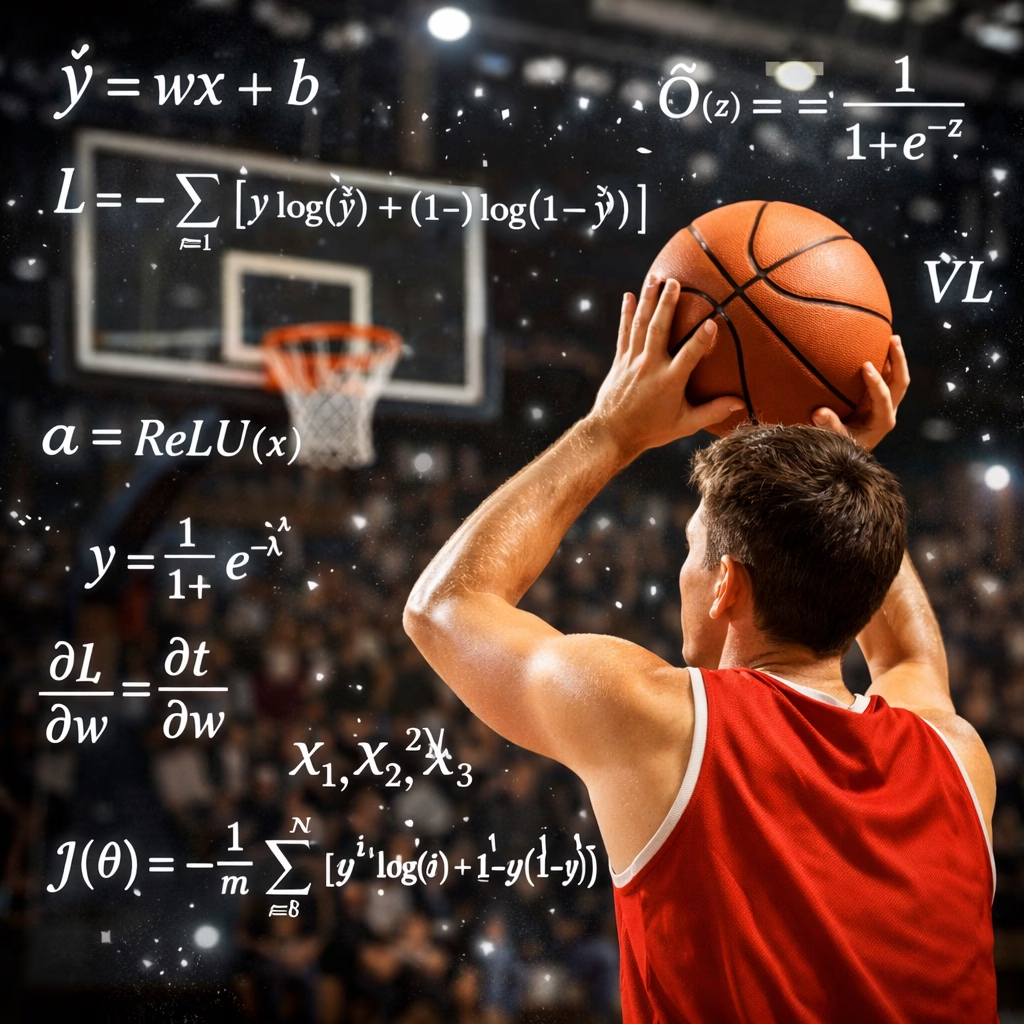
Deep learning concepts for beginners often feel intimidating, filled with equations, unfamiliar terms, and abstract explanations. But at its core, deep learning is simply about learning through practice and feedback. To make these ideas easier to understand, this article explains key deep learning concepts using a familiar analogy: a basketball player learning how to make the perfect shot. By the end, you’ll see how neural networks learn, improve, and optimize—without needing a strong math background.
A basketball player stands at the free-throw line. The hoop is quiet. The ball feels heavy in the hands—not because it weighs more than usual, but because getting it right is hard. That’s a good place to begin thinking about neural networks, the backbone of deep learning in AI that drives everything from vision, speech to language processing including ChatGPT..
A neural network, at its core, is a learner. It takes in information, makes a prediction, checks how wrong it was, and adjusts—again and again—until the prediction improves. Like a player training shots, it doesn’t “understand” the game in a human way. It improves through practice and feedback.
Let’s use that training journey to understand the most important deep learning concepts—without the math overload.
1) Data Preparedness: Training Starts Before the First Shot
Before a player can improve, you must give them practice conditions that make learning possible. In deep learning, that “practice setup” is your data.
Vectorization: Organizing Information the Learner Can Use
A player can’t learn from a messy pile of thoughts:
- jump height
- distance from the basket
- ball grip
- wrist angle
all floating around in no particular order.
So we turn those into a clean list of measurable inputs—almost like handing the player flashcards. Each flashcard is one piece of information, clearly written and consistently presented.
That is vectorization: converting raw information into a structured numerical form a model can work with.
Normalization: Keeping Practice Conditions Fair
Now imagine one day the “ball weight” is 1 kg, and the next day it’s 20 kg. The player wouldn’t know what to fix—because the world keeps changing.
So we standardize conditions:
- same ball size
- same court markings
- consistent measurement scales
That is normalization: keeping values in a comparable range so learning is stable and smooth.
Beginner takeaway: A great model often starts with great preparation. Garbage in → garbage out, whether it’s basketball or deep learning.
2) Parameters: Weights and Bias Are the Player’s Adjustable Technique
In our analogy, the neural network is the player. The parameters are the parts of technique the player can change over time.
Weights: How Much the Player Relies on Each Skill
Think of “weights” as importance settings.
A player uses many skills while shooting:
- arm strength
- aim accuracy
- jump timing
Over time, the player might learn something important: “Aim accuracy matters more than jump height.” So the model increases the weight for aim and reduces the weight for what matters less.
That’s what weights do: they decide how strongly each input affects the final decision.
Bias: The Player’s Default Tendency
Bias is the player’s natural baseline style. Some players naturally shoot a bit higher. Some release earlier. Bias represents that built-in offset.
- Weights: Which skills matter most?
- Bias: What’s the default starting point?
A practical note (important for beginners)
When training begins, weights typically start random, not zero. If everything starts identical, the learner has no reason to develop different “preferences” between skills.
Bias can be zero initially, and often is.
If you remove an essential input (like aim), the ball won’t go in no matter how hard you try. That’s a useful reminder: models can’t learn what they can’t “see” in the data.
3) Activation Functions: The “Decision Filter” Inside the Brain
Even with good technique, a player needs a brain that interprets effort and outcome.
An activation function is that decision filter. It introduces non-linearity—meaning the model can learn complex patterns rather than behaving like a simple linear calculator.
Common ones, in plain language:
- ReLU: “If there’s positive effort, pass it forward.”
- Sigmoid: “Is it more like yes or no?” (great for binary outcomes)
- Tanh: “How confident am I, from -1 to 1?”
In basketball terms: activation is the internal rule that helps the learner treat some situations differently from others—rather than acting the same on every throw.
4) Forward Propagation: Taking the Shot
This is the moment the player actually shoots using their current technique.
In neural networks, forward propagation means:
- take inputs (distance, angle, grip…)
- apply weights (importance of each input)
- add bias (default tendency)
- produce an output (the shot prediction)
Forward propagation is simply: the attempt.
5) Loss Function: Measuring “How Wrong Was That?”
After the shot, we need a scorecard—not applause.
- missed badly → high loss
- almost went in → lower loss
- perfect swish → very low loss
A loss function turns performance into a single number.
If you’re doing classification (like predicting “in” vs “out”), a common choice is cross-entropy loss—which strongly penalizes confident wrong answers (like being sure the shot will go in when it doesn’t).
Beginner takeaway: Loss isn’t punishment. It’s information.
6) Backpropagation: The Coach Rewinds the Shot
A good coach doesn’t just say “missed.” They say why.
- “Your elbow flared out.”
- “Too much force.”
- “Release was late.”
Backpropagation is the model’s way of rewinding the play and figuring out which internal settings caused the mistake—so it knows what to adjust. In simple words:
Backpropagation = learning from error by tracing it back to the cause.
7) Gradient Descent: Improving With Small, Repeatable Adjustments
Now comes the practice loop. The player takes a shot, measures error, adjusts slightly, repeats.
- too big an adjustment → wild inconsistency
- too small → slow progress
Gradient descent is the strategy of improving step-by-step with the right-sized corrections.
Gradient descent = practice, feedback, micro-adjustments, improvement.
8) Parameters vs Hyperparameters: What the Player Learns vs What You Set
This distinction matters because it reveals who controls what.
Parameters (Learned by the Player)
These change during training:
- wrist flick intensity
- release angle
- throwing force
In deep learning: weights and bias are parameters.
Hyperparameters (Set by Player)
These guide how training happens:
- how many practice shots (epochs)
- how long each session runs
- learning rate (how big the adjustments are)
- number of layers (how complex the “brain” is)
In short:
Parameters are learned. Hyperparameters are chosen.
The Complete Picture: Neural Networks as Training
| Neural Network Concept | Basketball Analogy |
|---|---|
| Vectorization | Organizing variables (distance, angle, grip…) |
| Normalization | Standard practice conditions for stable learning |
| Weights | Importance of each skill in the shot |
| Bias | Default shooting tendency |
| Activation Function | Decision filter that shapes responses |
| Forward Propagation | Taking the shot |
| Loss Function | Measuring how wrong the shot was |
| Backpropagation | Coach feedback + identifying what to change |
| Gradient Descent | Repeat practice with small improvements |
Want to learn more about everyday use of AI?
Discover more from Debabrata Pruseth
Subscribe to get the latest posts sent to your email.